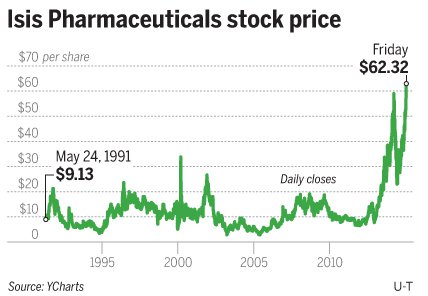
Shares of Isis Pharmaceuticals closed Friday at an all-time high of $62.32. Isis edged up 45 cents for the day, nosing out the previous record of $61.87, reached Thursday.
The Carlsbad biotech is up 63 percent from a year ago, and more than six times its price on Dec. 12, 2012, when it closed at $9.57 per share. Its market value now exceeds $7 billion, making it one of the most highly valued public companies in San Diego County.
The rise occurred as Isis advanced more drugs in its pipeline to late-stage development. Six are now in Phase 3 testing, and more than a dozen in Phase 2. Isis reached a number of milestones this year, including:
— On Dec 7, the company announced positive Phase 2 results for its venous thrombosis inhibitor, which reduced the rate of thrombosis without boosting the rate of bleeding.
— On Oct. 10, Isis announced positive Phase 2 results for its drug to treat spinal muscular atrophy, which in its severest form can kill in infancy.
— On Sept. 2, Isis provided evidence that its already approved cardiovascular drug, Kynamro, dramatically reduces risks of heart attacks. The week before, Isis also announced the start of a Phase 3 trial for another heart medication, ISIS-APOCIIIRx.
Isis drugs use a technology called antisense that blocks or modifies the activity of RNA molecules that guide protein synthesis. The promise of antisense is that it can interfere with diseases near their genetic beginning.
In some cases, such as with APOCIIIRx, antisense drugs inhibit production of a disease-causing protein. In other cases, the drugs increase production of a needed protein. In spinal muscular atrophy, for example, the loss of a neuroprotective protein is compensated for by increasing protein synthesis from a related gene.
The venous thrombosis drug, if it is proven safe and effective, will provide another illustration of what antisense can do. The drug is intended to reduce thrombosis without increasing bleeding, a goal called the “Holy Grail” of thrombosis therapy.
The drug, ISIS-FXIRx, inhibits production of Factor XI, which takes part in the cascade of events that lead to blood coagulation. Preclinical studies indicates that reducing production of Factor XI inhibits coagulation without causing more bleeding.
Articles about the drug published earlier this week in the New England Journal of Medicine provide suggestive but inconclusive evidence of the “Holy Grail” effect, according to Michael Schmidt, an analyst who covers Isis for Leerink Partners. Leerink makes a market in Isis stock.
“We believe ISIS-FXIRx could represent a possible therapeutic option for patients not currently addressable with existing anticoagulants (e.g., FXa or thrombin inhibitors) such as patients who are in need of chronic anticoagulant therapy and are at high risk of bleeding, pending additional Phase II trials ISIS will conduct next,” Schmidt wrote in a Dec. 8 research note to clients.
But others remain skeptical, such as Adam Feuerstein, a prominent biotech columnist at TheStreet.com. Using Twitter to address investor/biotech consultant Dirk Haussecker, an Isis bull who goes as @RNAiAnalyst, Feuerstein stated Wednesday that Isis is overrated.